Content warning: death, suicide, self harm
We have been reporting on the national LeDeR programme: ‘Learning from Lives and Deaths: People with a Learning Disability and autistic people’. LeDeR is the main way this country finds out why autistic people and people with learning disabilities are dying too young, what could have prevented their deaths, and whether anything is being done to stop the same things happening to others. We are concerned that the changes could make it harder to find those answers, and harder to hold those responsible to account.
We last updated on this work in July 2026, here, and now have more to add.
Background
Almost a decade after LeDeR began and much longer since the problem was first recognised, adults with a learning disability and autistic people still die younger and more often by avoidable deaths than other people. Even in the most recent national LeDeR report, over 50% of the reviews of adults with a learning disability found they died before they were 65. For adults in the general population, only 15% die before they are 65.
Far fewer deaths of autistic adults without learning disabilities are reported to LeDeR. For autistic adults whose deaths were reviewed in the last national report, nearly a fifth had a history of suicide attempts or self-harm, and suicide was one of the main causes of death.
Even the Government says the inequalities are unacceptable, saying the latest report “highlights continued inequalities, including that adults with a learning disability die on average 19 years younger than the general population which remains unacceptable.” Baroness Merron and Preet Kaur Gill, July 2026
However, that same statement says that the Government is changing the LeDeR programme and there will no longer be a yearly national report. We would like to tell you whether the new system will be better or worse, but not enough details have been provided for us to make that judgement yet.
How does LeDeR work at the moment?
Until now, LeDeR has worked roughly like this:
Every single stage is vital.
- Without deaths being reported, they cannot be reviewed.
- Without lots of reviews, local areas can’t understand what’s going well and what they need to change.
- Without the same types of review in every area, we can’t compare one area with another.
- Without local reports, the public can’t see what’s happening in their area.
- Without looking at all the reports, we can’t see if the same things are happening in lots of different areas.
- Without national analysis, big patterns and urgent national actions may be missed.
- Without the pressure to comment, Government can remain silent on the death inequalities faced by autistic people and people with learning disabilities.
Why are we concerned about the new system?
The Government says the new process will be an improvement. However, very little detail has been made public and we are concerned about what we have heard so far.
What the Government says so far | Our concerns |
|---|---|
NHS staff, people with lived experience and charities have been involved in improving the LeDeR review process.
| We have seen no adverts for autistic people to help with this work.
We have asked all the biggest national autism charities and none seem to have been included, either by working on it themselves or by helping find people with lived experience. |
There will be a new way of doing LeDeR reviews. | This is likely to be a simplified process and may not be as thorough or as good as the existing system. That means the learning may not be as good. Without input from the right people, this new process may miss key factors and lose important information about why people are dying. |
There will be a dataset instead of a national report. | A dataset may tell us what is happening, but it is unlikely to explain why, what needs to change, and whether previous recommendations have been acted on.
Other NHS datasets have serious gaps. We need to know how Government will make sure the new LeDeR dataset is complete and accurate.
Without a separate organisation writing national reports, we are concerned about who will check the information and challenge the Government if it is incomplete or misleading. |
Local areas are expected to continue prioritising LeDeR as part of reducing health inequalities. | Some local areas have already paused LeDeR reviews for significant periods, and we will be publishing information about that soon.
It is not enough for Government to tell local areas that this work is ‘expected’, it has to be something they MUST do, and somebody needs to check that they have done it. |
So... we have been working on getting LeDeR into a new law
We have already written to Government ministers about LeDeR, receiving a reply in August 2025 from Stephen Kinnock, who was then the Minister of State for Care. That reply did not provide the reassurance we’d hoped for. Since then, two more national LeDeR reports have been published and they bear out our concerns that not enough is being done.
The LeDeR Policy from 2021, which describes how LeDeR should work, was published by NHS England. At the moment, NHS England is being abolished by Government, with its activities being taken on by others, such as ministers and the Department of Health and Social Care. We have been trying to find out what will happen to the LeDeR policy at that point.
Decisions are being made about who will do what after NHS England has gone. These decisions are included in a new law called the Health Bill. This bill does not yet mention LeDeR at all. It is currently going through Parliament, which means there are still chances to influence it.
We are grateful for the support of Chris Coghlan, MP, and his team. Together, we planned a change to the Health Bill that would protect the key features of LeDeR in law. The proposed change would have made sure that deaths continue to be reviewed, that local areas report publicly, and that there is independent national analysis and reporting.
Changes to a law that’s being developed are called amendments. Chris sent his amendment and tried to speak about it in the House of Commons debate on September 8th. However, he was not given the chance to speak and the amendment was not included.
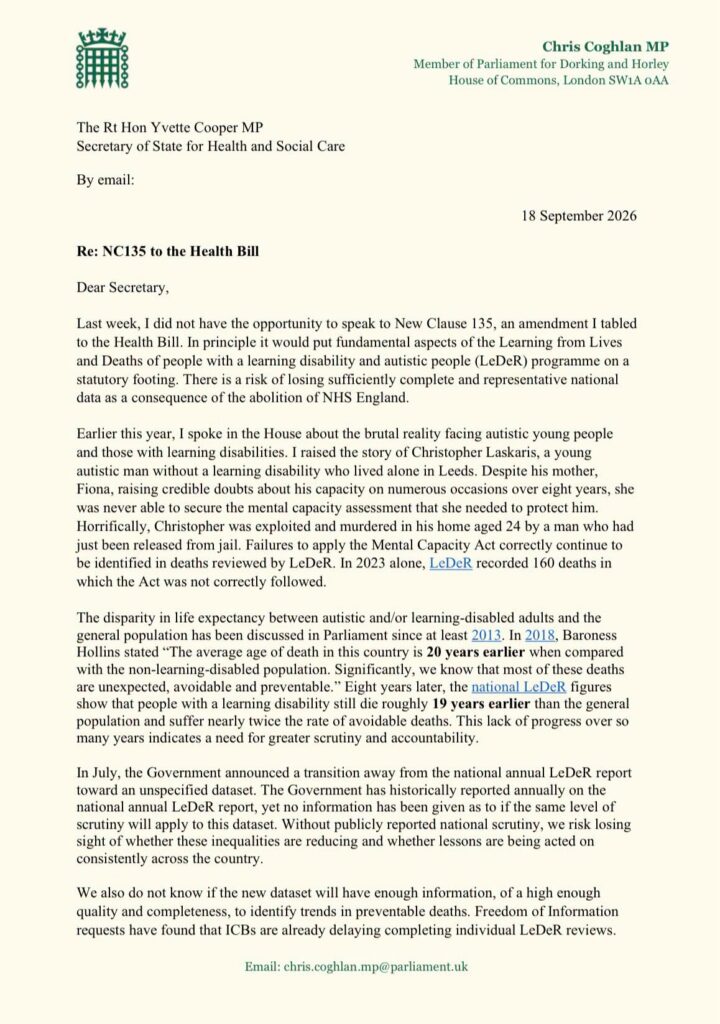
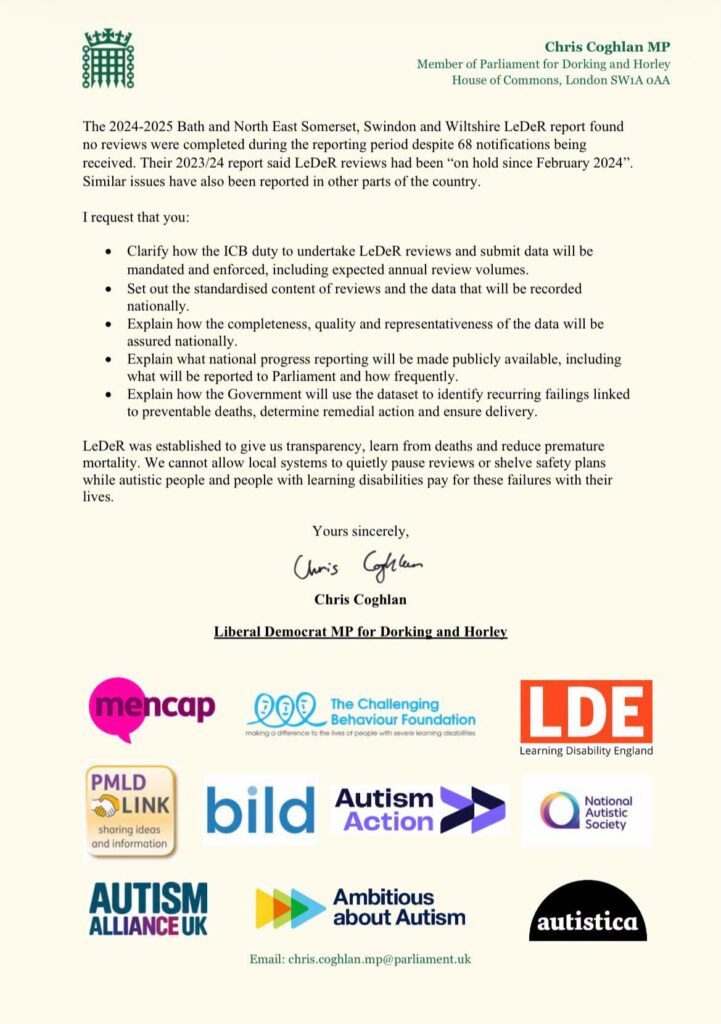
On September 18th, Chris followed up with a letter to Yvette Cooper, the current Secretary of State for Health and Social Care. Nine other major charities also signed the letter. You can read the letter to Yvette Cooper at the bottom of this post. We are still awaiting a response as of October 15th.
The House of Lords can now influence the new law
We are now talking to members of the House of Lords, because they have the next chance to add things to the Health Bill. On October 13th, there was a debate in the House of Lords, and several members took the opportunity to raise issues about autistic people, people with learning disabilities, and LeDeR:
Baroness Hollins gave the latest LeDeR figures about deaths and said it was concerning that the future of the LeDeR programme is in doubt.
Baroness Leaman said the bill doesn’t mention autism or ADHD at all, yet it changes who runs the things those people rely on, including data (which of course includes LeDeR) and the views of people with lived experience.
Baroness Browning talked about autistic people dying on hospital wards and called for patient records to include important information such as hospital passports, which she said can make all the difference for autistic people.
Lord Scriven has already asked a number of parliamentary questions about LeDeR in recent months. In this debate, he raised concerns about the health inequalities faced by people with learning disabilities and said he would return to these during the next stage of the Bill. He also raised wider concerns about accountability and patient safety.
We have been assured that an amendment about LeDeR will be put forward during this stage and we will continue to push for that.
Want to take action?
There are several things you can do.
Write to your MP. The Health Bill is now in the House of Lords. If the Lords agrees changes to the Bill, those changes will come back to the House of Commons, where MPs will have to decide whether to accept them. There could be a vote, so it matters that your MP knows about this now.
You can find your MP and how to contact them via the official Government website. You could email them to say why this issue matters to you, and ask them to write to Yvette Cooper, the Secretary of State for Health and Social Care, asking how the Government will make sure that:
- every death of a person with a learning disability or an autistic person is still properly reviewed
- local areas have to publish what they have learned and what they are doing about it
- there is still independent national reporting, so everyone can see whether things are getting better.
Report a death. If a person with a learning disability or an autistic person has died, anyone can report it to LeDeR. You can find more information about what happens if you report a death, and decide whether to do so, at leder.nhs.uk/report.
Tell us if you were involved. If you took part in NHS England’s work to develop a new LeDeR review process, please get in touch via info@autismaction.org.uk.
Get our LeDeR updates. Sign up to hear when we publish our findings on local areas, and what happens next with the Health Bill.
Letter sent to the Secretary of State: